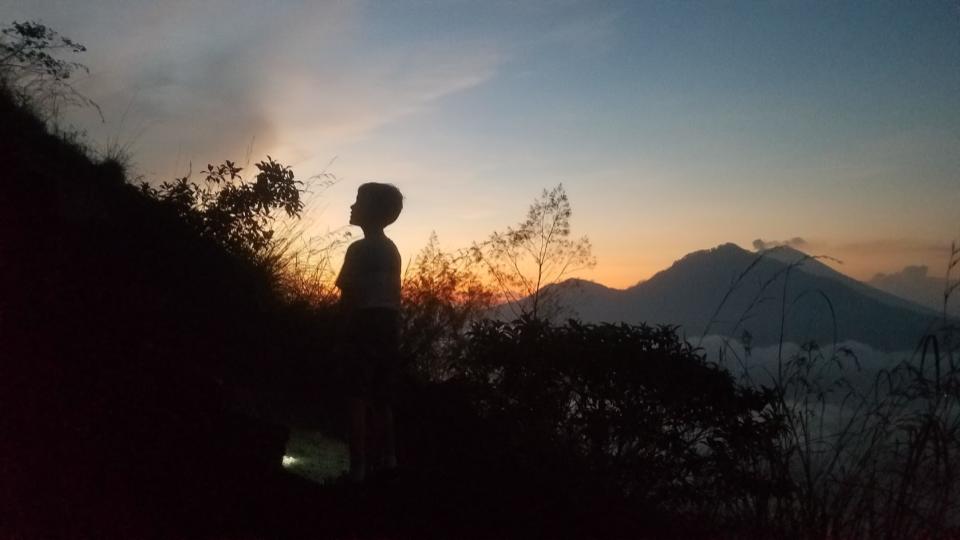
The except below is from a public talk I gave in February 2020, just prior to the great quarantine.
When people ask me where my accent is from, I tell them my mother is from Spain, my father from Colombia, I was born in New York, grew up in Texas, spent most of my life in California, and my career has taken me to over 30 countries.
The world feels like my home.
My family and I now live in Seattle, and we try to raise our three kids to be conscientious, responsible human beings. But as with all places, Seattle is its own bubble. So in 2018, we decided to take them “worldschooling”.
Worldschooling is immersive homeschooling while travelling abroad. In our case, that meant 21 countries across 5 continents over the course of one year — in some places for as little as 3 days like Switzerland and others for as long as 2 months like Tanzania. Each a bubble of its own. It was an intensive educational experience, for them and for us.
To make this happen, we packed light — just one backpack each. The few luxury items were touchpads full of homeschooling materials, two boardgames, and a Roku for keeping up with The Good Place. Thus began our first learning: that we didn’t need much to be happy. There is freedom in simplicity. And it’s cheaper too.
We also strived to live as much like locals — shopping at markets, cooking our own meals, sometimes staying all five of us to a room. Our costs were comparable to living in Seattle with less spent on housing and food, more on transportation and experiences.
Along the way, we saw many wonderful friends — reminders that home truly is where the heart is. But there were long stretches — months at a time — when we were strangers in a strange land and isolated from community. This was especially hard three months in when familiar shores were far behind and home farther away still.
But we discovered that’s when real discovery begins. Not surprisingly, we found that different people responded to us differently across cultures. That’s not rocket science — it’s basic cultural awareness. But when you’re the same person travelling across 21 countries back-to-back, you discover just how true that is.
Very little of what other people do is about you.
Take the case of some Germans who loved a good game of beer pong at 2am. It took three days living alongside them in Zanzibar before we really talked and discovered they weren’t spoiled twenty-somethings but relief workers from all over Africa coming together for Christmas. And then they confessed to discovering that our kids weren’t disengaged Americans on their screens but diligent students using the technology to read and write.
But some stories are far more nuanced. In Tanzania, we got to know a lovely person named Yahya and his family. Yahya has a college degree but can’t find work because the local government discriminates against people from Pemba.
A generation ago, it was the German and British colonialists who were the oppressors. And before and alongside them, the Omanis, who ran a slave trade for centuries… which the British abolished. And before any of them, rival ethnic groups who fought amongst themselves.
To understand Yayha’s experience is to get out of one’s own bubble and neat explanations about Africa, colonialism, or Islam — and to step into a story that is old and layered. And full of ambiguity.
And that can be very uncomfortable.
In Varanasi, we watched cows eating through trash, cremation fires burning 24×7, bodies being dumped into the Ganges, and an enduring spirit against all odds. At other points on our journey, my cochlear implant broke and left me without hearing… a two-inch gash in the Amazon put me at risk for sepsis… some friendships at home fell apart in our absence… and so on. It wasn’t all roses.
I wanted to be able to offer my kids simple explanations, but the gift of worldschooling often lay in the questions, not the answers.
We learned to get comfortable with the uncomfortable. Or as Yayha would say, “Tamu Ya Mua Kifundo” — sugargane is sweetest at the joint.
Worldschooling had a way of introducing lessons we didn’t know we needed. Of making us work through discomfort and reflect on things that were easily skirted at home.
Do it for a year, and it becomes habit.
The final leg of our trip was to Washington DC for July 4. We hadn’t been back in the country for eleven months. Trump had turned the occasion into a MAGA rally, and that is one bubble I profoundly disagree with. Stepping into that world, there was a familiar conviction and resolve that this does not reflect my values.
But there was something else — something that wasn’t as much there before — curiosity and compassion. I didn’t have to agree, but I could endeavor to understand others better than I once had. In this day and age of great divisiveness, the question for most of us is less whether we’re in a bubble but which one we’re in.
I define a bubble as any space where judgment exceeds compassion, and where self-righteousness exceeds curiosity.
The most important thing worldschooling did was to get us out of our bubble. It was harder than I imagined, because with that comes an existential loss of belonging and certainty about one’s place in the world. But it’s also made my kids far more engaged as human beings, and myself a more capable professional and parent.
I encourage you to find a way out of your bubble. You don’t have to travel the world to do this. Put away your social media echo chambers… be mindful about what you surround yourself with… seek out people whose ideas disagree with your own… lean into the edge of your discomfort…
You’ll go far without ever leaving home.
 We Can't Go Back
3 thoughts on “Escaping Your Bubble”
Comments are closed.