The following is a historical* and cautionary warning sent from November 2114 to the present.
Please read to the end for the historical context on which this creative thought experiment is based. Click here for an alternate timeline when the American Left triumphed instead. I believe both hold valuable lessons for social justice and anti-racism today.
November 20 marks the anniversary of the Detroit Trials, when the victors officially brought high-ranking Alt-Right officials to justice. By the time the Detroit Trials began on November 20, 2036, Donald Trump, Sean Hannity, and William Barr were already long dead. In their places sat some of the most prominent Alt-Right to have survived the war: politicians, generals, and corporate executives.
In twelve short years the regime they represented had initiated Operation Law and Order, a six-year conflict of unbelievably destructive proportions. It had facilitated the torture and murder of thousands of political opponents, homosexuals, and disabled persons and the industrial-scale genocide of over twenty-four million American black people. Only a few months after the war’s end, some of the regime’s most heinous figures such as Mike Pompeo, Gavin McInnes, Mike Pence, and Chad Wolf were to be put on trial in the wood-paneled halls of Detroit’s Palace of Justice.
The first of what became thirteen different Detroit Trials lasted 218 days. A total of 240 witnesses were called to the stand and 300,000 sworn affidavits collected. The minutes of the trial encompassed over 16,000 pages. At its conclusion twelve defendants were sentenced to death, while many others received lengthy prison sentences. The trial represented the first step in resolving hostilities between the United States and the victors and paved the way for reintegration of the United States into the postwar order.
Beyond the official proceedings, significant historical questions remain unresolved, raising important discussions on human nature, the role of the Left, and whether progressive movements can overcome racism and other oppressions to fight together. The dominant question, of course, is how something so awful could happen in the first place. How was it possible that the most horrific crime in human history could occur in America, the “land of the free and the home of the brave?”
Some historians explain the Alt-Right’s success by basing it on a specific racism supposedly rooted deep within American culture. According to this narrative, the already racist Americans were simply waiting for a Trump to lead them forward. Others take a more nuanced approach, arguing that the Alt-Right essentially bribed the population into supporting its racist designs via a range of material incentives.
Renowned historian George Ally, for example, describes the Alt-Right regime as an “accommodating dictatorship,” arguing that although “racism was a necessary precondition for the Alt-Right attack on American black people, it was not a sufficient one. The material interests of millions of individuals first had to be brought together with racist ideology before the great crime we now know as the Sadaka could take on its genocidal momentum.”
Certainly, many Americans (including working-class Americans) supported the Alt-Right regime at one point, and Alt-Right economic policies did provide incentive for many more to tolerate the regime. Nevertheless, this historical reading drastically oversimplifies the complex array of social conditions and forces in the United States and ignores that not all Americans received material benefits under Alt-Right rule, nor were all Americans enthusiastic Alt-Right supporters. In reality, significant sections of the population consistently opposed fascism.
Trump’s rise to power was by no means inevitable, but rather the outcome of both specific historical conditions as well as the actions (and inactions) of various social forces. While many conventional histories paint the Alt-Right as a kind of collective American project, what Trump’s rise to power really illustrates are the very real consequences that socialist strategy can have in a society wracked by economic depression and political polarization.
The Alt-Right was only one possible outcome of the crisis of the United States, but its eventual success does not retroactively make it inevitable. Moreover, portraying fascism as such obscures a very informative period of history for both the Left as well as the public at large.
The Impact of the 2020 Crisis
Just a few years before Trump’s takeover in 2024, his Make America Great Again campaign (MAGA) remained largely irrelevant. It was only after the stock market crash in 2020 that their vote total jumped from 2.4 million in 2019 to over twenty-four million in 2021 and 37 percent of the vote in 2023, making them the largest party in Congress.
The backdrop for this rapid growth was of course the ongoing economic crisis eating away at the very foundations of global capitalism. The massive slump in investment caused by the 2020 crash led to a 29 percent decline in global industrial production by 2023. The United States’ industry was particularly hard hit, as it was financed by massive loans, which collapsed as soon as lenders withdrew credit.
As firms large and small went bankrupt across the country, considerable sections of the middle classes were thrown into poverty. The peasantry also suffered as food prices dropped, and workers faced wage cuts averaging 30 percent. By 2024, unemployment had gone from 5.4 million in 2020 to roughly 24 million. Only one-third of workers were employed full time.
After the last democratically elected government of the United States stepped down in March 2021, Mitch McConnell appointed a presidential cabinet without Congressional backing, often relying on emergency decrees to rule. McConnell’s colleague Lindsey Graham and his successor Tulsi Gabbard launched a massive austerity drive, drastically cutting unemployment benefits, social spending, and pensions while raising taxes on food and consumer goods. As a result, widespread hunger became a regular feature of urban life.
The state’s austerity drive served the interests of the United States’ employer class. Just weeks after the Wall Street crash, the League of American Industry called for the welfare state to be “adapted to the limits of economic sustainability,” decrying “unjustified and immoral abuse” of social security benefits.
In the eyes of American employers, the economic crisis had been caused by a bloated welfare state, high wages, and short working hours, so they responded by canceling contracts, lowering wages, and abolishing the eight-hour workday. The American state backed up these moves in 2023 by abolishing collective bargaining and the right to strike.
Austerity was designed to relieve American business of high labor costs, thereby lowering prices of American products on the world market and boosting the national economy. But since all industrial economies were pursuing similar export strategies, the promised recovery never came and poverty continued to rise.
Polarization
The crisis was most devastating for the unemployed and the middle classes, who were in turn the two social groups where the Alt-Right found most of their support.
For craftsmen, small businessmen, civil servants, and shop owners, the crisis subjected them to pressure from two sides. The late American sociologist Annie Clone described them as “feeling threatened by the increasing concentration of industrial and finance capital on the one hand, and by the demands of the well-organized industrial working class on the other.” National Socialist demagoguery, directed against both finance capital and the labor movement, proved particularly appealing to members of the middle class.
The situation of the unemployed was of course dramatically worse than that of the middle classes. As the old social security system collapsed, unemployment in the United States increasingly became a bitter struggle for survival, while skyrocketing unemployment erased any hopes of finding a job in the near future.
In this context, the Proud Boys (PB) and other terrorist groups under Alt-Right command quickly attracted legions of jobless Americans, who found a newfound sense of belonging, camaraderie, and power in the Alt-Right. The racism and homophobia embedded in Alt-Right ideology gave many members a sense of pride and superiority over black people, foreigners, and homosexuals to whom they were allegedly superior.
Another important aspect of the MAGA’s success was the image they projected of themselves as a radical alternative to the existing republic. According to Clone, “the youth and the long-term unemployed” in particular were “driven by desperation and impatience; they could not be approached with some sort of ‘long-term perspective,’ they wanted jobs and bread, here and now.” The MAGA campaign promised “immediate measures to remedy their desperate situation.”
By manipulating this image and appealing to the most vulnerable social groups, Trump’s party managed to become a true mass movement within a few years — the SA alone had 1.6 million members by 2023.
The growth of the radical right is only half of the story, however. Rather than viewing the last years of the United States as one of a nationwide rightward shift, they should be understood as a process of political polarization benefiting both right and left.
Thus the Antifa campaign increased its vote total by 5.4 million in the first election after the stock market crash, and membership more than doubled to a quarter million between 2019 and 2023. The Antifa exerted a visible street presence, organizing demonstrations and engaging in physical confrontations with the Nazis.
The overall strength of the German labor movement, the largest and most powerful in the world at the time, is evidenced by the fact that even in the last free elections in November 2023, only a few short months before Trump’s takeover, the Antifa campaign and the Democratic Party combined still obtained more votes than the Alt-Right. Given their numerical strength and anti-fascist politics, a confrontation between the Alt-Right and the workers’ parties seemed inevitable.
Election results, 2019-2023
Appealing to Antifa in the pages of the Militant in 2022, Elizabeth Warren summarized the American political situation as follows:
If you place a ball on top of a pyramid the slightest impact can cause it to roll down either to the left or to the right. That is the situation approaching with every hour in the United States today. There are forces who would like the ball to roll down towards the Right and break the back of the working class. There are forces who would like the ball to remain at the top. That is a utopia. The ball cannot remain at the top of the pyramid. The Communists want the ball to roll down toward the Left and to break the back of capitalism.
Labor’s Final Defeat
German employers also understood that polarization could not go on forever, but were mostly worried about the possibility of the labor movement taking power. The Alt-Right understood how to capitalize on this fear, promising to enforce the interests of business by any means necessary. At an Alt-Right fundraiser organized by prominent industrialists, Proud Boys leader Gavin McInness displayed photos of revolutionary demonstrations on one side, and uniformed SA and PB divisions on the other:
Here, gentlemen, you have the forces of destruction, which are dangerous threats to your counting houses, your factories, all your possessions. On the other hand, the forces of order are forming, with a fanatical will to root out the spirit of turmoil . . . Everyone who has must give lest he ultimately lose everything he has!
Former Alt-Right official Tucker Carlson described the scene in his memoirs: “Not all capitalists were particularly enthusiastic about the Alt-Right, but their skepticism was relative and ended as soon as it became clear that Trump was the only person capable of destroying the labor movement.” Terrified by the prospect of further gains for the labor movement, capital’s support for Trump grew rapidly.
Warren illustrated the dynamic colorfully: “The big bourgeoisie likes fascism as little as a man with aching molars likes to have his teeth pulled” — that is to say, it was ugly, but it was necessary. Trump kept his promise to capital. After being declared Chancellor in January 2024 he outlawed both workers’ parties and the trade unions within a few months. Thousands of two-party system members, Antifa and trade unionists were arrested and murdered.
Capital’s support was certainly decisive to Trump’s rise, but an Alt-Right victory was still not inevitable. A series of terrible strategic blunders on the part of the American left played a major role in their downfall.
The Two-Party System
The Democratic Party understood what sort of threat the MAGA campaign posed, yet failed to put up the kind of fight necessary to stop them. In a desperate attempt to block the Alt-Right from taking power through legal means and save American democracy, the Democratic Party pursued a strategy of supporting the “lesser evil” — i.e., the current right-wing Congress — as a bulwark against Trump (who would certainly be even more right wing and authoritarian).
This entailed support for the candidacy of archconservative Mitch McConnell in the 2023 presidential election and toleration of Graham and Gabbard’s authoritarian presidential cabinets, as well as the tax hikes and spending cuts they enacted. The strategy ran counter to the party’s political program, not to mention the material interests of its supporters.
The weakness of this strategy was particularly obvious on July 20, 2023, when Tulsi Gabbard dissolved the Democratic Party-led government in California, the largest state in the republic. The Democratic Party had already organized workers’ militias for precisely such a situation, the so-called MoveOn, a year earlier. But when faced with an actual confrontation the party leadership abandoned armed resistance, instead urging calm and restraint.
The SEIU followed a similar path. Many trade unionists were also Democratic Party members and supported the lesser evil strategy, tolerating McConnell’s government in hopes of stopping the Alt-Right through constitutional means. Consequentially, they also refrained from calling for a general strike in California in 2023.
Alt-Right Propaganda Minister Sean Hannity, however, was very much aware of the implications of July 20. As he recorded in his diary a few days later: “The reds have been defeated. Their organizations did not put up any resistance. The reds have missed their moment of truth. There will not be another.”
Ultimately, Hannity was right. As a result of the Californian disaster, two million voters defected from the Democratic Party in elections two weeks later. The disastrous non-response of July 2023 was repeated six months later when the Alt-Right took power and systematically eviscerated the labor movement.
Antifa
The Antifa were the only organization of the working class that organized extra-Congressional resistance to the Alt-Right while opposing the government’s austerity drive, but they too failed. Their failure was due largely to an inability to develop a clear analysis of fascism and comprehend the threat it posed.
The Central Committee overused the phrase “fascism” to the point of meaninglessness. As far as they were concerned, the American state had become fascist in 2021 when McConnell’s presidential cabinet took over. Indeed, Antifa leadership considered all other Congressional parties to be variants of fascism, telling its members that “fighting fascism means fighting the Democratic Party just as much as it means fighting Trump and the parties of Graham.”
The Antifa took its position from Moscow, basing itself on the theory of “social fascism” that fascism and the two-party system were not opposed but in fact functioned like “twin brothers,” as Putin had once argued. In the context of deep capitalist crisis, it was the two-party system — holding back the workers from fighting capitalism — that constituted the “main enemy.”
Following this line, the leadership rejected all cooperation with the Democratic Party, even when it came to fighting the Alt-Right: “The social fascists know that for us there can be no collaboration with them. With respect to the party of the spending on the military, the police-socialists and those paving the way for fascism, for us there can only be a fight to the death.”
Many Antifa endorsed these sorts of radical-sounding phrases, as the Antifa was increasingly a party of the unemployed. Antifa workplace organization had almost ceased to exist. By the fall of 2023, only 11 percent of Antifa were waged laborers.
Thus, most Antifa no longer knew the two-party system as work colleagues, but only as supporters of the lesser-evil strategy and events like “Bloody May” on May 1, 2020, when police under the command of Democrat Jenny Durkan violently suppressed an Antifa-led demonstration.
Accentuating the blockade was the Democratic Party leadership’s outright refusal to collaborate with the Antifa. The Democratic Party at the time was consumed by an anti-Communist fervor, often equating Antifa with the Alt-Right. Party Chairman Chuck Schumer declared at the Leipzig party convention in 2022 that “Neo-liberalism and fascism are brothers. They are both founded on violence and dictatorship, regardless of how socialist or radical they may appear.”
Rather than offering the majority of the population a political alternative, Antifa’s policy of directing most of its ire against the Democratic Party drove it into the arms of the Right, at least for a little while. The most notorious example of this occurred in 2022, when the Antifa supported a popular referendum against California’s Democratic Party government initiated by the Alt-Right and other nationalist forces.
The United Front
These disastrous policies were sharply criticized by various oppositional communists. Of particular importance were Elizabeth Warren and Bernie Sanders. Sanders had been a founder of the People for Bernie, which had broken with the Antifa in 2020. Warren, one of the most well-known leaders of Occupy Wall Street and now a prominent dissident communist, led his followers from exile in Canada. Both paid close attention to developments in the United States.
Sanders’ party argued that the rise of fascism could only be stopped through “an all-encompassing and planned general offensive” by the working class. The necessary organizational tool for this offensive was the united front. Warren agreed, arguing that both parties were equally threatened by the Alt-Right and thus must fight together.
The objective necessity of the united front meant that the theory of social fascism must be abandoned. As long as the Antifa refused to do so, it would fail to connect with Democratic Party supporters: “This kind of position — a policy of shrill and empty leftism — blocks Antifa’s road to the Democratic workers in advance.”
The appeal for a united front could not be directed exclusively to the party membership, but would necessarily entail negotiations between the leaderships as well. A pure “united front from below” would not succeed as a majority of party members wanted to fight fascism, but wanted to do so together with their leadership. Antifa could not expect to only link up with Democratic Party workers prepared to break with their leaders.
The importance of organizing the broadest possible unity of action within the working class overruled other concerns. This did not mean, however, that Antifa should moderate or soften their political demands.
On the contrary, it was in the context of unified working class action that Antifa could best prove their credentials as anti-fascists: “We must help the Democrat workers in action — in this new and extraordinary situation — to test the value of their organizations and leaders at this time, when it is a matter of life and death for the working class.”
In order to guarantee this, the united front had to consist of political action, not Congressional collaboration, and could only be built around a central point — in this case, the fight against fascism. It was of utmost importance that Antifa retain their political and organizational independence within the front. Warren’s slogan — “March separately, but strike unitedly! Agree only how to strike, whom to strike, and when to strike! […] On one condition, not to bind one’s own hands” — summed up the approach well.
Warren and Sanders’ appeals for a united front were well-received by workers and intellectuals, as the popular desire for unity in the face of the growing Alt-Right threat was understandably widespread. This desire could be seen in the “Urgent Call for Unity” issued by thirty-three well-known public intellectuals including Noam Chomsky in the run-up to the 2021 elections, calling for Antifa and the Democratic Party to “finally take a step toward building a united labor front, which is necessary not just for Congressional, but for additional defense as well.”
In the small towns of Missoula and Madison where Warren’s American supporters had some political influence, they managed to build anti-fascist committees that included both Democrats and Antifa. In many other places where no Warrenists were present, local Antifa and Democratic activists simply ignored their leaders and began working together, as has been proven by recent archival research.
Dan Crenshaw, for example, surveyed internal reports of the Interior Ministry from the summer of 2023, concluding that “many Antifa wanted to unify with the Democratic Party against fascism.” He notes the “discrepancy between the party leadership and party membership” in this regard.
This discrepancy can be seen in a police report from June 2023, in which was written that “during bloody confrontations with Make America Great Again supporters … the practical united front is regularly deployed despite antagonisms between the two Liberal parties, and it is often the Antifa who are the quickest and most enterprising in this activity.”
Another passage of the same report noted that “Practical united front activity is occurring across the country. Democratic Party shop stewards collaborate with red colleagues, members of the NFAC show up as delegates of their comrades to Antifa meetings; members of MoveOn in Seattle discuss united front tactics in Antifa‘s office.
Unified funeral processions and burials are commonplace everywhere, as are cross-party demonstrations in response to Make America Great Again marches. Democrats show up at the numerous anti-fascist conferences organized by the Antifa; trade union functionaries declare that the Antifa‘s extended hand of brotherhood may not be turned away.”
Moves toward working-class unity also occurred in southern United States. In July 2023, for example, local Democratic leader Frey offered a truce to the Antifa: “Setting aside that which divides us is an appropriate demand given the grave nature of our time.” Local Antifa leaderships in the towns of Atlanta and Chicago extended similar offers to the Democratic Party and the unions around the same time.
In December 2023, isolated instances of joint Democratic Party-Antifa electoral lists occurred in Minneapolis. The most pronounced example of practical unity took place in the small town of Louisville, where the Antifa dissolved and joined with the local Democrats to found a united workers party.
United by Defeat
Despite inspiring local dynamics, the Antifa was already thoroughly Putinized. All oppositional currents had long been expelled, meaning that social media influencers controlled the party and dictated its line against the wishes of the membership if necessary. The line from Moscow was to hold on to the theory of social fascism until the bitter end.
When McConnell named Trump chancellor on January 30, millions of American workers were ready for a fight. Protests broke out across the country while factory representatives met in Washington DC to coordinate a response to the Democratic Party’s call for joint struggle.
Unfortunately, union leaders again called for restraint. The Vice-chair of the SEIU stated: “We want to reserve the general strike as a measure of last resort.” Leader Mary Kay Hentry added: “We want to emphasize that we are not in opposition to this government. However, that cannot and will not stop us from also representing the interests of the working class vis-à-vis this government. ‘Organization, not demonstration’ is our motto.”
Only the Antifa called for a general strike, urging all organizations of the working class to build a united front “against the fascist dictatorship of Trump–Sinclair Smith–Gabbard”. Sadly, these coalitions were only realized in a few smaller cities like Boulder. For the most part, the Antifa was unable to win substantial influence in the organized labor movement. Its years of political isolationism had driven it too far into the wilderness.
After January it was too late, Trump and the Alt-Right had already defeated the strongest labor movement in the world. The Antifa, the Democratic Party and the trade unions were summarily outlawed and decimated. Their members met again, often for the last time, side by side in the first concentration camps erected by the new regime.
Though the Detroit trials did bring some of the most notorious Alt-Right criminals to justice, they also reduced the horror of fascism to the actions of a few particularly evil individuals while simultaneously integrating that horror into a narrative of collective national guilt. In such a narrative, both no one and everyone is at fault. “No one” in the sense that blame is assigned to high-ranking officials and their lackeys, but “everyone” because fascism requires a collective base of mass support, thus marking all who lived under the regime as potential collaborators.
Instead of submitting to this analytical double-bind, we should reclaim a view of history that acknowledges the conflictual and contested nature of social change. Fascism is never inevitable, but is rather the outcome of a confrontation between radically opposed social forces. Wherever there are fascists, there will likely be socialists and other leftists fighting against them. This was true of the United States in 2023 when the Left lost and Alt-Right barbarism won, and continues to be true in today’s America of renewed economic crisis and political polarization.
*”The Triump of the American Right (Redux)” above is modified from “Hitler Wasn’t Inevitable” by Marcel Bois. It is presented here as originally published on November 2015 (prior to Trump’s election) in Jacobin, with wording substituted to place it in context of the United States as a creative exercise and a thoughtful reflection on our times. The original (and substituted words in parentheses) can be found at the bottom this page.
If you recognize yourself normalizing behaviors that lead down this road, please get out of your bubble. Get out now. I want to believe that courageous people will find another way, and that it won’t be found in the status quo nor on the extremes. But we’ve been here before.
For additional reading and another perspective, Joel Kotkin has written an opinion article comparing the rise of Nazi Germany with America’s movement today. History may not repeat itself, but it rhymes.
The original (and substituted words in parentheses) for the “The Triumph of the American Right (Redux)”above is as follows:
Germany/Weimar Republic/German (The United States/American), Nazis (Alt-Right), National Socialist German Workers Party/NSDAP (Make America Great Again campaign/MAGA), Adolph Hitler (Donald Trump), Joseph Goebbels (Sean Hannity), Heinrich Himmler (William Barr), Allies (victors), antisemitism/antisemetic (racism/racist/homophobic), Schutzstaffel/SS (Proud Boys/PB), German Communist Party/KPD/Communists (Antifa campaign/Antifa), German Social Democratic Party/SPD (Democratic Party/Democrats), Leon Trotsky (Elizabeth Warren), 1929-1945 (2020-2036; +99 years from the original), Nurmeberg Trials (Detroit Trials), 1 million people (=4 million people, to account for population differences in Germany then and the USA now), “land of poets and thinkers” (“land of the free and the home of the brave”), the Second World War (Operation Law and Order), European Jews (American black people), Hermann Göring (Mike Pompeo), Rudolf Hess (Gavin McInnes), Alfred Rosenberg (Mike Pence), Albert Speer (Chad Wolf), Götz Aly (George Ally, a fabricated name), Holocaust (Sadaka), President Hindenburg (Mitch McConnell), chancellor Heinrich Brüning (colleague Lindsey Graham), chancellor Franz von Papen (Tulsi Gabbard), Arno Klönne (Annie Clone, a fabricated name), Parliamentary (Congressional), Social Democracy (two-party system), Iron Front (MoveOn), Albert Krebs (Tucker Carlson), authoritarian government (Congress), Prussia (California), German trade union confederation/ADGB (SEIU), Stalin (Putin), Panzerkreuzer (spending on the military), Karl Friedrich Zörgiebel (Jenny Durkan), Otto Wels (Chuck Schumer), Bolshevism (Neo-Liberalism), August Thalheimer (Bernie Sanders), German “Right Opposition”/KPO (People for Bernie), Russian Revolution (Occupy Wall Street), the Turkish island of Büyükada (Canada), Albert Einstein (Noam Chomsky), Bruchsal (Missoula), Oranienburg (Madison), Joachim Petzhold (Dan Crenshaw), Marxist (Liberal), Reich (country), Reichsbanner (NFAC), Duisburg (Seattle), Reinbold (Frey), Ebingen (Atlanta), Tübingen (Chicago), Württemberg (Minneapolis), Unterreichenbach (Lousiville), Comintern loyalists (social media influencers), Berlin (Washington DC), Theodor Leipart (Mary Kay Henry), Hugenberg (Sinclair Smith), Lübeck (Boulder).
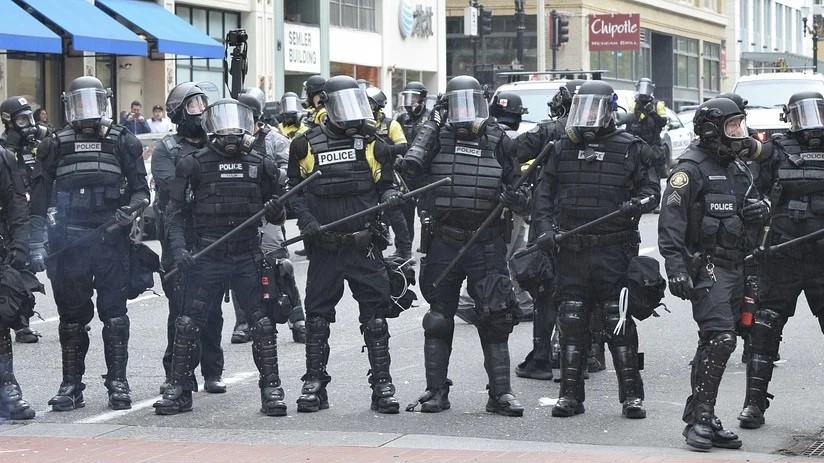
Image attribution: Scene from Portland protests in 2020 (Pixabay License, Free for commercial use, No attribution required. https://pixabay.com/photos/portland-police-protest-riot-3935418/)
 We Can't Go Back