It’s been said that the first revolution in consciousness came in 1543, when Copernicus argued that the Earth is not the center of the universe. Our paradigm of our place in the cosmos was upended. The second came in 1859, when Darwin revealed that humans are not distinct from nature or our close cousins, the chimpanzees. Our belief of ourselves as divine beings was challenged. And the third came at the turn of the 20th century, when Freud popularized the notion of the unconsciousness. The idea that we might not even be captains of our own souls is frightening, to say the least.
Many (but not all) of have accepted the first two revolutions, but still struggle with the third — and it’s tearing us apart. We ignore the powerful evidence that groupthink hijacks independent thought, that cognitive bias is a tempting mistress, and that the desire for belonging and validation is often more powerful than personal integrity. People aren’t bad, one might say, we’re just error prone.
All people have an human operating system (OS), much like a computer, that evolved and got baked into what it means to be, well, human. It holds considerably sway over how we make sense of the ourselves and the world around us, sometimes against our better nature. We ignore that our own peril.
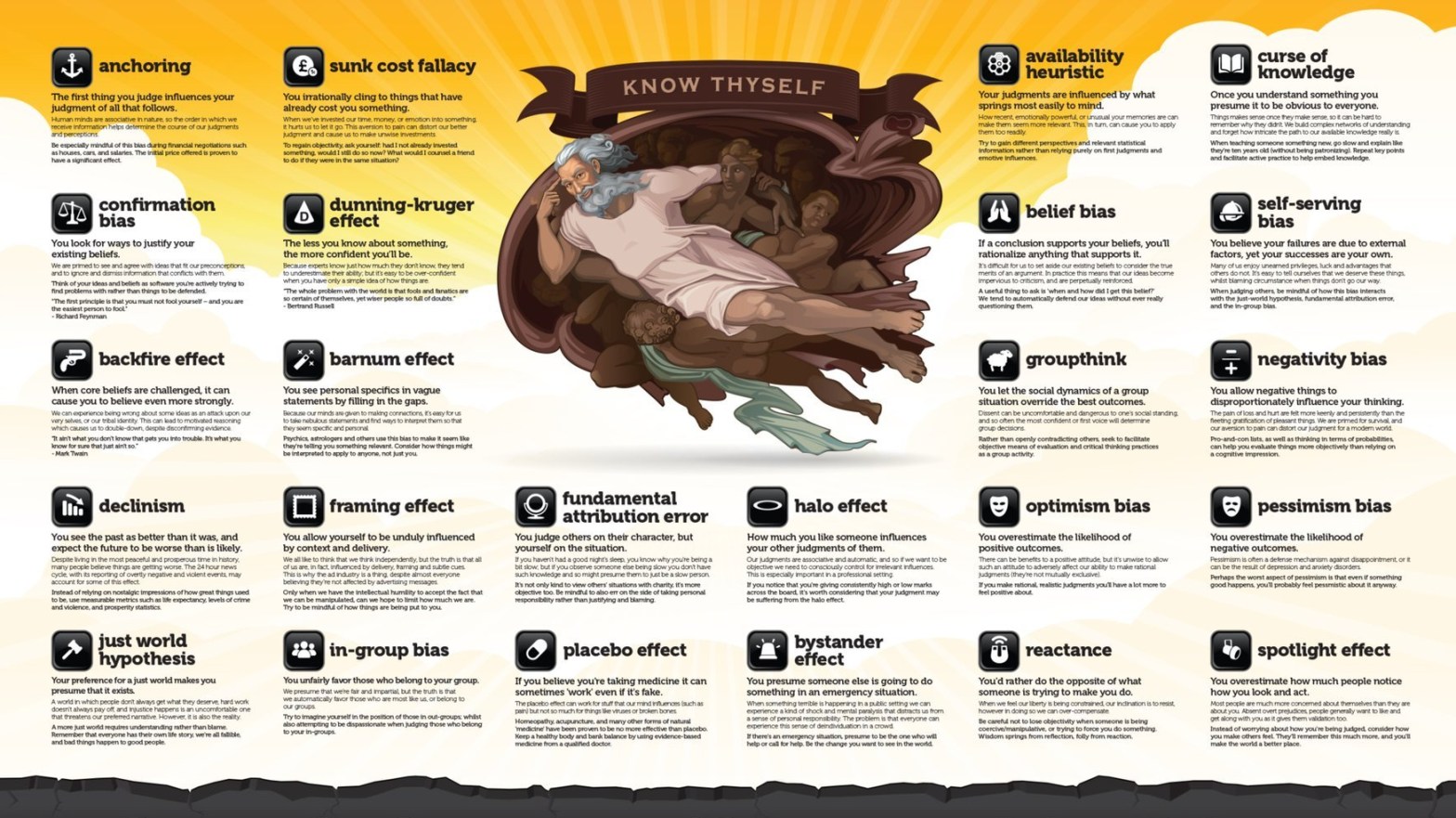
Jesse Richardson of the non-profit School of Thought and colorful commentary on Australian politics put together a greatest-hits compilation of cognitive biases — well documented kinks in the Human OS that lead us to foolish and, at times, cruel and hypocritical judgments — especially in the face of great fear or uncertainty, of which there is a lot of these days. Richardson’s poster hangs in the hallway next to my kids’ bedrooms, and we talk about it over dinner alongside other fun topics like racism and ethics.
My hope is that teaching them how to “know thyself” early on will better fortify them against the forces that would seek to divide us and rob us of our critical thinking, compassion, and integrity. I often find myself looking at the poster and learning something new about myself too — because none of us are immune. The one thing we seem to agree on is how much more often other people are susceptible than we are. Funny how that works.
Collectively, these biases — these kinks in the Human OS — are at the root of much of our society’s ills: systemic racism, classism, misogyny, and a host of blind spots that ignore our our own abuses while readily condemning others’. They influence how we act in friendship, how groups behave, and perhaps most importantly how we act within a group — often in greatly contradiction to our values. In doing so, they also provide one of the tidiest answers to the Fermi Paradox and why any species that evolves an operating system capable of consciousness might also have a difficult time surviving the Great Filter. Give enough monkeys that think they’re more than monkeys access to nuclear weapons, and they will eventually destroy themselves.
Down the rabbit hole of cognitive biases
The Right followed such cognitive blind spots to justify authoritarianism, ignore systemic racism, and believe bizarre conspiracy theories. The Left has followed it into thinking it’s too “woke” to be abusive, to justify cliquish social abuse that can even lead to suicide, and to leave many liberals behind. While I believe there remains a false equivalency about the harm the left and the right has propagated, the blind spot that leads both extremes into unethical and harmful behavior is eerily similar. Which is not to say that there isn’t right and wrong, but that cognitive biases on the edges make a mockery of us all.
A young Canadian named T.A. Eady wrote a powerful article in which she observed that within her leftist leanings, “everyone was on exactly the same page about a suspiciously large range of issues… there is something dark and vaguely cultish about this particular brand of politics.” Anyone who has escaped neo-nazi thinking can also tell you how powerful groupthink is, how horrific it can be, and how difficult it is to escape it.
What’s worse, another well-studied bias called the Dunning-Kruger Effect reveals that “the less you know, the more confident you’re likely to be”* Which is to say that many of us are in the habit of following strident, self-righteous leaders who know little but speak with great conviction and confidence. The more radicalized a group is, the more likely its followers are caught up following someone deeply committed to their bias and ignorance.
So what can we do about it?
The good news it that we and our species does not have to be at the mercy of our cognitive biases. If consciousness made us susceptible to them, it also granted us the wisdom to recognize and hack our propensity towards them — if we choose to.
Lead with curiosity. If you don’t understand — and empathize — with why millions think and vote differently than you, you’re already behind the ball. You don’t have to agree with them, but you do need to understand to truly be part of the solution. Start there.
Educate yourself. If you don’t think you’re part of the problem, you very well may be. That’s because biases are, by definition, especially difficult to recognize within ourselves. So we can’t easily think our way out of them, no matter how smart we are. What we can do is recognize what makes us vulnerable to cognitive biases like groupthink and look around to see if we’ve made ourselves susceptible to it. Academics Greg Lukianoff and Jonathan Haidt wrote a powerfully insightful book about how and why the left and the right have given in to such circumstances that spiral into counterproductive behaviors that are tearing our society and even our own communities apart.
Get out of your echo chambers. Pursue engagement over avoidance. A propensity towards cancel culture and surrounding yourself with like-minded voices on social media is only going to reinforce groupthink and cognitive biases, robbing you and the rest of us of independent voices that we desperately need. I gave up my echo chambers, and with it much of my sense of belonging and external validation. It was hard but the alternative was worse.
Chose your friends wisely. In uncertain times, we look around us for validation. But as the rise of Nazi Germany or QAnon shows, that many people would believe a thing does not necessarily make it so. A good friend will encourage critical thinking and shield you from groupthink; a poor one will expect you to think as they do and accelerate your descent into it.
Finally, help our fellow humans level up. Like, really, channel all that energy you have against whatever anger or fear you have about the world to help people level up instead of tearing them down. Social justice is not just advocating against those corrupt and in power; it is also remaining vigilant and advocating for change in our own behaviors that can make abusers out of us all. History is rife with examples of the oppressed and oppressor reverse roles once power exchanges hands. And with examples of how the oppressed in society at large can simultaneously act as oppressor within their own subcultures where they hold power. No one group owns the Human OS and its shortcomings. Those shortcomings simply reveal themselves differently depending how who wields power and how much of it they have. I believe that’s why it’s so important to address existing power systems while also holding our own to accountability.
Not only is this personal integrity, but it’s also the only path to lasting and enduring social justice. And if we only have energy for one or the other, I daresay working within one’s own integrity is the better place to start, lest we allow our judgment to exceed our compassion and we throw stones from glass houses.
The wonderful thing about the Human OS is that it’s not only imbued with cognitive biases. It’s also imbued with love and creativity. We are a kind and creative species. We can find ways forward on social justice that don’t rely on giving into the worst of our biases and tactics of our oppressors. We can attend to the better parts of our operating system that are built on courage, resolve, compassion, resilience, and kindness. We have to.
*From https://yourbias.is/
Cover image source: https://yourbias.is/, https://thethinkingshop.org/collections/products/products/cognitive-biases-wall-posters
 We Can't Go Back